
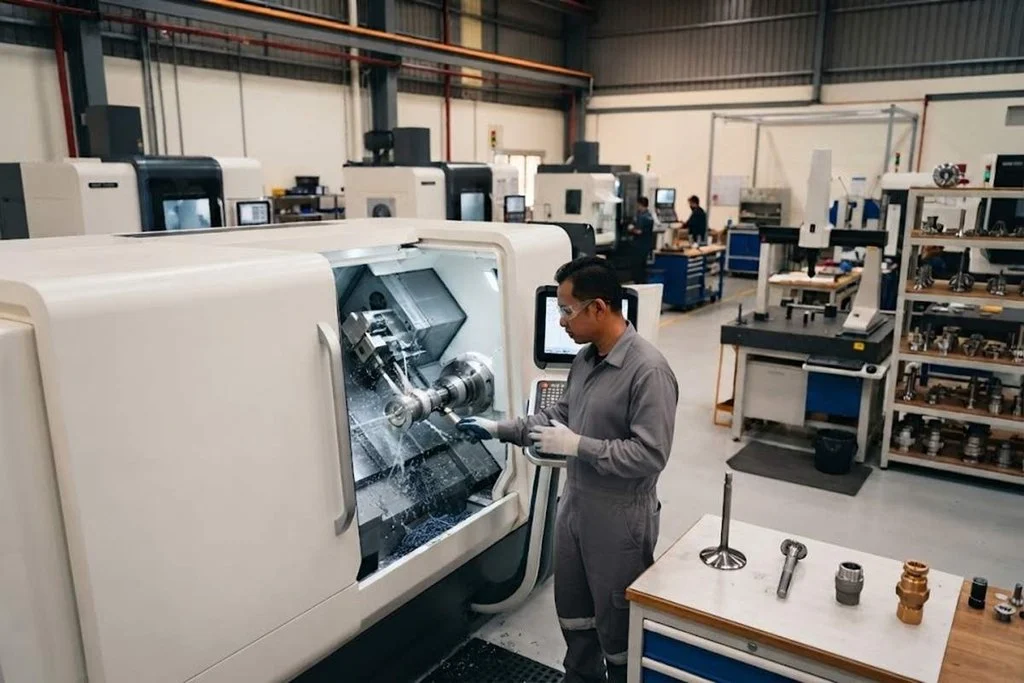
CNC machining turning has become an important manufacturing process in Malaysia, supporting industries that require accurate, repeatable, and high-quality components. CNC Machining Turning Malaysia refers to computer-controlled turning processes used to shape materials into precise cylindrical components. These machines can manufacture parts such as shafts, bushings, pins, sleeves, fittings, and threaded components according to detailed digital specifications.
Malaysia has developed a strong manufacturing sector, making CNC machining turning valuable across many industries. Companies use this technology to improve production consistency, reduce material waste, and manufacture complex components efficiently. From automotive factories to medical equipment manufacturers, CNC turning plays a role in producing parts that meet strict dimensional and quality requirements.
Automotive Industry
The automotive industry is one of the major users of CNC Machining Turning Malaysia services. Vehicle manufacturers and component suppliers need large quantities of precisely manufactured parts for engines, transmissions, steering systems, braking assemblies, and other mechanical applications. CNC turning allows manufacturers to maintain consistent dimensions when producing large numbers of similar components.
Automotive parts often need to withstand vibration, friction, heat, and continuous movement. CNC machining helps manufacturers produce components with controlled tolerances and smooth surface finishes. Malaysian automotive suppliers can also use CNC turning for prototypes and customized parts before moving into larger-scale production.
Aerospace Industry
The aerospace sector requires components manufactured with exceptional accuracy because even small dimensional differences can affect the performance of an aircraft system. CNC turning is therefore used to produce precision parts for aircraft structures, engines, landing systems, and other aerospace applications.
Aerospace manufacturers may work with materials such as aluminum, titanium, stainless steel, and specialized alloys. These materials can be challenging to machine using conventional methods. Modern CNC turning equipment provides controlled cutting operations that can help manufacturers achieve the required shapes and tolerances while maintaining repeatability during production.
Medical Industry
Medical equipment and device manufacturers also depend on precision machining. CNC turning can be used to manufacture components for surgical instruments, diagnostic equipment, implants, and other medical products. These parts often require accurate dimensions and carefully controlled surfaces.
Medical manufacturing also places considerable importance on material selection and cleanliness. Depending on the application, manufacturers may machine stainless steel, titanium, and other materials suitable for medical environments. CNC technology enables manufacturers to produce small and intricate components consistently, which is particularly useful when developing specialized medical equipment.
Electronics Industry
Malaysia has a well-established electronics and electrical manufacturing sector, and CNC turning supports the production of various precision components used in this field. Although many electronic products contain extremely small parts, CNC machining is particularly useful for mechanical components, housings, connectors, shafts, fixtures, and equipment used during manufacturing.
Precision is important because electronic manufacturing equipment often depends on components fitting together accurately. CNC turning allows manufacturers to create repeatable parts based on digital specifications. It can also support low-volume production and custom tooling, which is useful when companies introduce new products or modify existing manufacturing processes.
Oil and Gas Industry
Malaysia’s oil and gas sector uses precision-machined components for equipment operating in demanding environments. CNC turning can produce parts such as valves, couplings, shafts, bushings, fittings, and other cylindrical components required for industrial machinery.
Components used in oil and gas applications may be exposed to pressure, corrosion, temperature changes, and heavy mechanical loads. As a result, manufacturers need reliable production methods and suitable engineering materials. CNC machining can provide the dimensional accuracy required for components that must work together in complex industrial systems.
Marine Industry
The marine industry is another sector where CNC Machining Turning Malaysia has practical applications. Shipbuilders, marine equipment manufacturers, and maintenance companies require accurately manufactured parts for propulsion systems, pumps, engines, and other onboard machinery.
Marine components often need to operate under demanding conditions involving moisture, saltwater, vibration, and continuous mechanical movement. CNC turning can produce replacement parts and specialized components according to precise measurements. This is particularly useful for maintenance operations where an original component may need to be reproduced or modified.
Industrial Machinery
Industrial machinery manufacturers are among the regular users of CNC turning in Malaysia. Factories depend on machinery containing numerous moving and rotating components, including rollers, shafts, gears, bushings, pins, and spacers. CNC machining provides an efficient way to manufacture these parts with consistent dimensions.
Common Applications:
- CNC turning may be used for:
- Shafts and rotating components
- Bushings and sleeves
- Threaded components
- Rollers and pins
- Custom machine parts
Manufacturers can produce both standard and customized components depending on the requirements of their equipment. CNC machining is also useful for replacement parts, especially when a company needs a component that is no longer readily available from the original equipment manufacturer.
Construction Industry
The construction sector uses machinery and equipment that contain numerous precision components. CNC Machining Turning Malaysia can support the manufacture of parts for construction machinery, hydraulic systems, lifting equipment, and other mechanical applications.
Construction equipment operates under heavy loads and challenging working conditions. Components therefore need to be manufactured accurately so that moving assemblies can function properly. CNC turning can also be used to produce customized replacement parts, helping equipment maintenance companies restore machinery without depending entirely on imported components.
Robotics and Automation
As Malaysian manufacturers increasingly adopt automation, CNC turning has become relevant to robotics and automated production systems. Robotic equipment requires accurately manufactured shafts, joints, pins, couplings, spacers, and other mechanical components to achieve reliable movement.
Precision is especially important when several components must work together repeatedly. CNC machining provides repeatable manufacturing based on computer-controlled designs. This makes it suitable for producing components for automated machinery, robotic systems, assembly equipment, and specialized production lines.
PTD as Your Trusted Choice
Professional Tools & Dies Sdn Bhd (PTD) provides precision machining and tooling solutions for businesses across various industries. The company focuses on producing accurate, high-quality components while meeting specific customer requirements and project specifications.
With reliable manufacturing capabilities and attention to detail, it supports customers with customized parts, prototypes, tooling, and precision-engineered solutions. Its commitment to quality and consistent workmanship makes it a practical choice for companies seeking dependable machining services in Malaysia.
For more information about PTD’s services and capabilities, visit:
Conclusion
CNC Machining Turning Malaysia supports a wide range of industries, including automotive, aerospace, medical, electronics, oil and gas, marine, industrial machinery, construction, robotics, automation, and defense manufacturing. Its ability to produce accurate and repeatable cylindrical components makes it valuable for applications where quality and dimensional consistency are important.
As Malaysian manufacturing continues to develop, precision machining is expected to remain an important part of industrial production. Companies that require customized components, prototypes, or large production quantities can use CNC turning to achieve consistent manufacturing results while meeting specific engineering requirements.
