
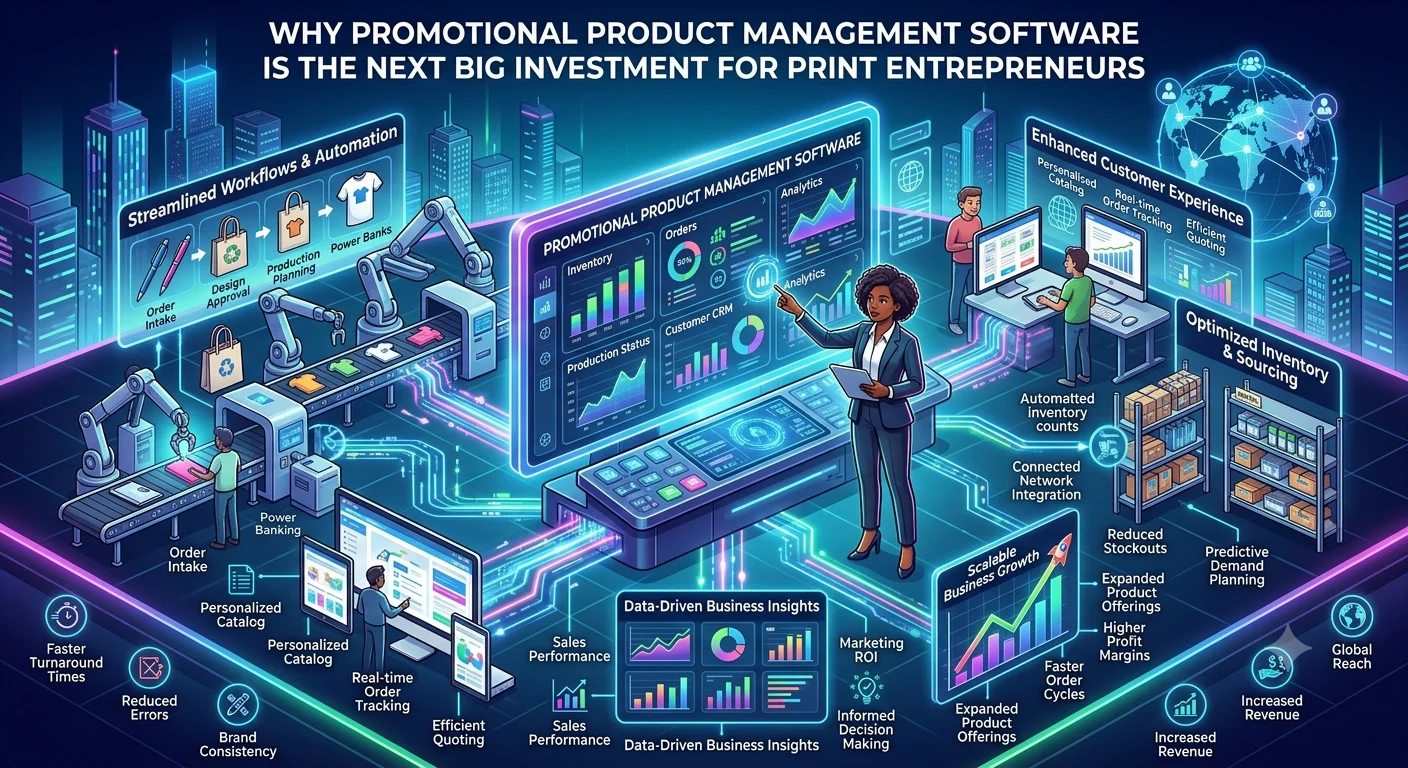
Every founder who has ever priced out a promotional products business gets the same piece of advice within the first month: get software. Spreadsheets don’t scale, the advice goes, so buy a platform before the mess catches up with you. That advice isn’t wrong. It’s just incomplete, because it treats software as a standalone yes-or-no decision when, for a print entrepreneur, it never is one.
The Case Everyone Makes, and Why It’s True as Far as It Goes
The efficiency argument for promotional product management software is easy to make because it’s accurate. A platform that centralizes your catalog and quotes jobs automatically also routes orders straight to suppliers, which removes hours of manual reconciliation every week. Fewer pricing errors reach the client. Proofing gets faster. None of that is in dispute, and most of what’s written about “the next software investment” for a promo business stops right there, at the case for buying.
The problem with stopping there is that it answers a question nobody in your position is actually asking. You’re not choosing between software and doing nothing. You’re choosing between software and the other three or four things that same $5,000, $15,000, or $40,000 could buy you this quarter.
Every Dollar Has a Next-Best Use, and Software Competes with All of Them
A print entrepreneur with limited capital is running a constant, unspoken auction. A decoration presses. A part-time production hires. A first outside sales rep. Ad spend to get the phone ringing. More raw inventory to stop turning away rush jobs. Promotional product software sits in that same queue, and it has to out-earn whichever of those is next in line, not just outperform a blank spreadsheet.
This is where the “next big investment” framing that dominates most advice columns quietly falls apart. It isn’t wrong that software pays for itself. It’s wrong that software pays for itself first, for every founder, at every stage. Sequence matters just as much as the return itself.
The Right Comparison Isn’t Software vs. Spreadsheet, It’s Software vs. Whatever Else That Money Buys
Take the numbers seriously, and the comparison gets uncomfortable fast. A basic DTG setup (printer plus a pretreatment unit) runs at least $17,350 in upfront cost before consumables, per YoPrint’s published cost breakdown, and a standalone heat press alone can run $200 to $2,000 depending on capability.
On the labor side, a promotional products sales rep with a base salary runs $40,000 to $50,000 a year before commission, and the national average total compensation for the role sits at roughly $76,681, according to ZipRecruiter’s April 2026 salary data.
Promotional product management software, by contrast, starts far lower: PrintXpand’ s own Web-to-Print Storefront has an entry point around $300, though custom mid-market platforms for growing operations commonly run closer to $1,000 a month once modules and supplier integrations get added in.
So which wins? Here’s the honest answer: it depends on what’s actually broken. Got no production capacity yet? A $300 storefront doesn’t print anything, and a press does. Is the phone just not ringing? A sales hire moves that needle in a way catalog software never will, at least not directly. Software’s return only shows up once there’s order volume flowing through your business that a person is currently reconciling by hand. Buy it before that point exists, and you’ve bought a subscription, not a return.
What the Industry Data Actually Shows About Small Distributors
It’s tempting to assume the threshold is about company size, that once you cross some revenue line you “graduate” into needing software. The data doesn’t support that. PPAI’s 2025 Sales Volume Estimate, published January 12, 2026, put total US promotional products sales at $27.1 billion, up 1.3% year over year. Split by distributor size, large distributors (over $2.5 million in annual sales) held 54% of that volume and grew 1.31%. Small distributors (under $2.5 million) held 46% and grew 1.29%. Practically identical. Being small isn’t what’s holding growth back, and being large isn’t the advantage either.
What actually diverges is channel mix. Online sales reached $7.1 billion in 2025, 26.3% of total industry volume, per the same PPAI report. And within that, online sales among distributors under $2.5 million grew 11.4%, roughly nine times the industry’s blended growth rate. The founders pulling ahead aren’t the ones who got bigger first. They’re the ones whose order flow shifted toward something a platform can actually process without a person retyping it.
So, When Does the Math Flip in Software’s Favor?
Here’s where I’ll commit to a real answer instead of the usual “it depends.” Once repeat orders and catalog-browse requests start making up something close to a quarter of your monthly order volume, roughly the industry’s own online-share benchmark, the manual-quoting model stops being the cheaper option. A $300 storefront handles unlimited repeat orders for a flat cost. A press or a sales hire scales cost in a straight line with every additional job. Below that share, you’re probably still solving a production or a demand problem, and the smarter dollar goes to equipment or a sales hire instead.
This won’t hold for every shop, and I’ll flag the obvious limitation here: it’s a rule of thumb built from public industry averages, not a certified formula for your specific business. A founder running high-touch, low-volume corporate gifting will hit that line at a different point than one running fast-turn event merchandise. Run your own numbers before you commit either way.
What Promotional Product Management Software Actually Replaces, Once You’re Past That Line
Once the volume is there, what the software buys back is specific, not vague. Catalog aggregation across SAGE and ASI supplier feeds means you’re not rebuilding pricing sheets by hand every time a supplier updates cost. CPQ and product configurator tools quote jobs by rule instead of by memory. Branded client portals and RFQ workflows move the “can you send me a quote” email out of your inbox and onto a page the client fills in themselves. Platforms like PrintXpand’ s promotional products software bundle this set specifically for the promo segment rather than adapting a generic commercial-print tool that wasn’t built for SAGE and ASI catalog data in the first place.
That distinction matters more than it sounds. A lot of “next big investment” advice quietly assumes any web-to-print software will do. It won’t. Commercial print software solves print production. Promo distribution has its own catalog logistics, and a platform that doesn’t natively speak that data format just becomes one more manual reconciliation step wearing a software interface.
Where the Investment Case Still Falls Apart
Credit where it’s due to the skeptics here: buying a platform too early is a real failure mode, not a hypothetical one. A founder with three clients and a handful of monthly orders doesn’t need CPQ rules or a branded portal. They need their fourth client. Software bought at that stage sits mostly unused, and the monthly cost quietly erodes exactly the margin the founder is trying to protect. This is also why a no-commitment trial period- PrintXpand offers a Free POC before any contract- matters more for this buyer than for an established distributor. It lets a founder test the fit against actual order volume before capital gets locked in.
Making the Call with the Money You Actually Have
None of this means promotional product software isn’t a genuinely good investment for print entrepreneurs. It usually is, once the order volume exists to justify it. But “the next big investment” isn’t a fixed answer sitting at the top of a checklist waiting for every founder to reach it on the same schedule. It’s a comparison you have to rerun every time you have capital to deploy, against whatever three or four alternatives are competing for that same dollar this quarter.
At PrintXpand, we’ve watched founders make this call in both directions, and the ones who got it right weren’t the ones who bought software fastest. They were the ones who could say, specifically, what problem the software was solving that a press, a hire, or an ad budget couldn’t solve better with the same money.
Author Bio
Pratik Shah is Creative Head at PrintXpand, a cloud and on-premises print and personalization platform serving 350+ print businesses across 40+ countries. Pratik works with promotional products distributors and print entrepreneurs to modernize quoting and order workflows without over-buying ahead of actual demand. Visit printxpand.com.
