
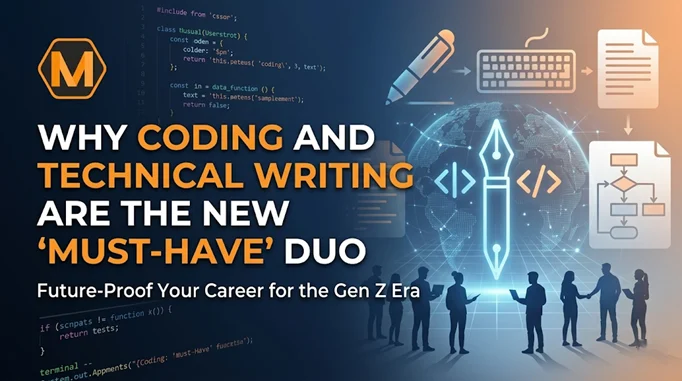
The modern professional landscape is undergoing a seismic shift. Gone are the days when you could neatly categorize yourself as either a “math person” or a “writer.” Today, the most successful individuals are those who can bridge the gap between complex logic and human communication. This intersection—where coding meets technical writing—has become the ultimate power couple in higher education and the global job market. For undergraduate students, mastering this duo isn’t just an advantage; it’s becoming a requirement for survival in a tech-driven economy.
As university curriculums evolve, students are finding that a biology lab report now requires Python scripts for data analysis, and a business proposal requires an understanding of software architecture. This overlap creates a heavy cognitive load. When the pressure of maintaining high grades across diverse subjects becomes overwhelming, many students choose to help me with my assignment by consulting experts who understand how to blend academic rigor with practical application. This support allows students to focus on mastering these new hybrid skills rather than just drowning in deadlines.
The Rise of the “Literate Coder”
In the past, “coding” was something done in a dark room by specialists, and “writing” was the domain of the humanities. However, in 2026, code is a form of literacy. If you can’t read a basic script, you are effectively locked out of many high-level discussions in finance, healthcare, and even the arts. But coding alone isn’t enough. If you can write a perfect loop but cannot explain to a stakeholder why that loop saves the company money, the code loses its value.
Technical writing is the “user interface” of the mind. It is the art of taking something incredibly dense—like an API or a chemical process—and making it digestible for someone else. When a student masters both, they become a translator. They can speak to the machines and the humans simultaneously. This dual capability is what recruiters call a “force multiplier,” meaning one person can do the work of a small team because they don’t need a middleman to explain their work.
Comparison: Traditional Writing vs. Modern Technical Documentation
| Feature | Traditional Academic Essays | Modern Technical Writing & Code |
| Primary Goal | Persuasion and Argumentation | Clarity and Functionality |
| Audience | Professors and Scholars | Users, Developers, and Stakeholders |
| Structure | Linear (Intro, Body, Conclusion) | Modular (Heads, Sub-heads, Snippets) |
| Tone | Formal and Often Decorative | Concise, Direct, and Actionable |
| Key Metric | Depth of Theory | Speed of Understanding |
Why Logic and Language are Two Sides of the Same Coin
At its core, coding is just a highly structured form of writing. Both require a clear beginning, a logical middle, and a functional end. In a Python script, if your “grammar” (syntax) is wrong, the program crashes. In an essay, if your “logic” is broken, the reader’s understanding crashes. Undergraduate students who realize this early on tend to excel because they stop seeing STEM and Humanities as enemies.
However, the transition into technical fields can be steep. Coding requires a specific type of precision that traditional schooling often skips. For those struggling with the steep learning curve of syntax and logic, seeking professional programming assignment help from a reliable source through MyAssignmentHelp can provide the clarity needed to move forward. Having a mentor or a professional guide walk you through a complex script ensures that you aren’t just copy-pasting solutions, but actually learning the architecture behind the language.
The Impact of AI on the Duo
There is a common misconception that AI will replace both writers and coders. The reality is the opposite: AI has made the combination of these skills more valuable. An AI can generate a block of code, but it often lacks the context of the specific project. A human who understands technical writing can audit that code, document its limitations, and explain its ethical implications.
Gen Z students are uniquely positioned to lead this “Human-in-the-Loop” era. By using tech tools to handle the repetitive parts of work, they can focus on high-level strategy. This involves knowing how to prompt a system, how to verify the output, and how to present the findings to a global audience. The “Must-Have Duo” is essentially the toolkit for the modern problem-solver.
Breaking Down the Global Demand
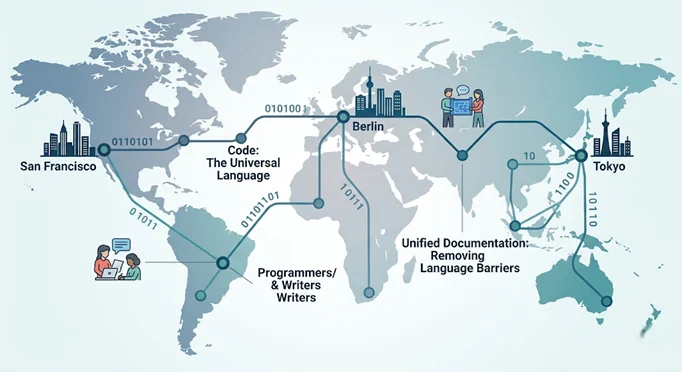
Why is this duo specifically a “global” trend? Because code is a universal language. A developer in Tokyo and a researcher in Berlin can both understand a well-documented C++ file. Technical writing ensures that the nuances of that code aren’t lost in translation. As remote work becomes the standard for many tech and consulting firms, the ability to write clear, asynchronous documentation is the only way to keep a global team synchronized.
For students, this means your “market” is no longer just your local city. If you can code and write, you can work for a startup in Silicon Valley while living in London or Sydney. You are no longer restricted by geography; you are only restricted by your ability to communicate your technical value.
Practical Tips for Mastering the Duo
- Read Code Like Literature: Don’t just look at what the code does; look at how it’s organized. Is it clean? Are the variables named logically?
- Write for the “Non-Expert”: Try explaining your most complex assignment to a friend who isn’t in your major. If they get confused, your technical writing needs work.
- Use Version Control: Learn tools like GitHub. Not just for the code, but for the “README” files. These files are the perfect practice ground for technical writing.
- Practice Consistency: In both writing and coding, consistency is king. Whether it’s your indentation or your tone of voice, keep it uniform.
The Psychological Benefit: Reducing Academic Anxiety
One of the biggest hurdles for undergraduates is “blank page syndrome.” This happens in both coding (the blinking cursor in the IDE) and writing (the white screen in Word). By treating them as the same skill, you can use the same brainstorming techniques for both. Break your code into “pseudocode” (plain English) before you type a single bracket. This reduces the intimidation factor and makes the task feel manageable.
When the workload becomes a mountain, remember that utilizing academic resources is a sign of a smart manager, not a struggling student. Balancing a heavy course load is about resource allocation. Knowing when to dive deep into a project and when to lean on external expertise to maintain your GPA is a professional skill in itself.
Conclusion: Your Future as a Hybrid Professional
The future does not belong to the specialists who refuse to look outside their niche. It belongs to the hybrid professionals who can navigate the complexities of software and the subtleties of human language. By investing time in both coding and technical writing, you are essentially “future-proofing” your career against whatever shifts the economy might take.
You are building a bridge. On one side is the raw power of technology, and on the other is the human need for clarity and connection. If you can stand in the middle of that bridge, you will always be in demand.
Frequently Asked Questions (FAQ)
Q1: Do I need to be a Computer Science major to learn coding?
Ans: No. In today’s market, even those in History, Sociology, or Marketing benefit from “data literacy.” Learning basic automation or data visualization with code is useful in almost every field.
Q2: Is technical writing different from creative writing?
Ans: Yes. While creative writing focuses on emotion and storytelling, technical writing focuses on utility and efficiency. The goal is to help the reader accomplish a task as quickly as possible.
Q3: How do these skills help with my university grades?
Ans: Most high-level assignments now require a “rationale” or a “methodology” section. If you can write these sections with the precision of a technical writer, your clarity will naturally lead to higher marks.
Q4: Can I learn these skills online?
Ans: Absolutely. There are countless open-source projects, documentation guides, and professional platforms designed to help students refine these skills. The key is consistent practice and seeking the right support when concepts become too complex.
Q5: Why is “Human-in-the-Loop” important?
Ans: As AI becomes more prevalent, the “Human-in-the-Loop” refers to the person who supervises, corrects, and explains the AI’s work. Without the human element of technical writing, AI-generated content can be misleading or incorrect.
About The Author
I’m Ruby Walker, an academic consultant and content strategist dedicated to helping students navigate the complexities of modern higher education. With years of experience at MyAssignmentHelp, I specialize in bridging the gap between rigorous academic research and practical, industry-ready skills. My goal is to empower the next generation of learners by providing them with the tools and insights they need to excel in both traditional STEM fields and evolving digital landscapes.
